Psychedelics #3
Nonsense Palindromes
Rick Griffin and The Grateful Dead
Copyright 5-1-23 / 1,888 words
by Jon Kramer
Nonfiction. These events are from the 60s – 90s.
I love color, sometimes loud, even obnoxious at times. Not on houses, which are too big, nostalgic, and long-lasting to sustain bright primary colors. But lunch boxes (there used to be such things), tennis shoes, T-shirts and LP album covers of old – bring on the riot.
While I was growing up one of the most revered, color-splashing artists in the country was Rick Griffin. He rose to popularity in the Hippie Era, as a central figure in the Psychedelic Art movement in California. In the 1960s, Griffin and his wife moved to San Francisco where they became common guests at Ken Kesey’s “Acid Test” parties (LSD was legal at the time). His first real art exhibition was at the one-year anniversary of the Psychedelic Shop on Haight Street with members of his troop, the Jook Savages. It was likely at this venue that he met his immediate future in the way of a strange new band.
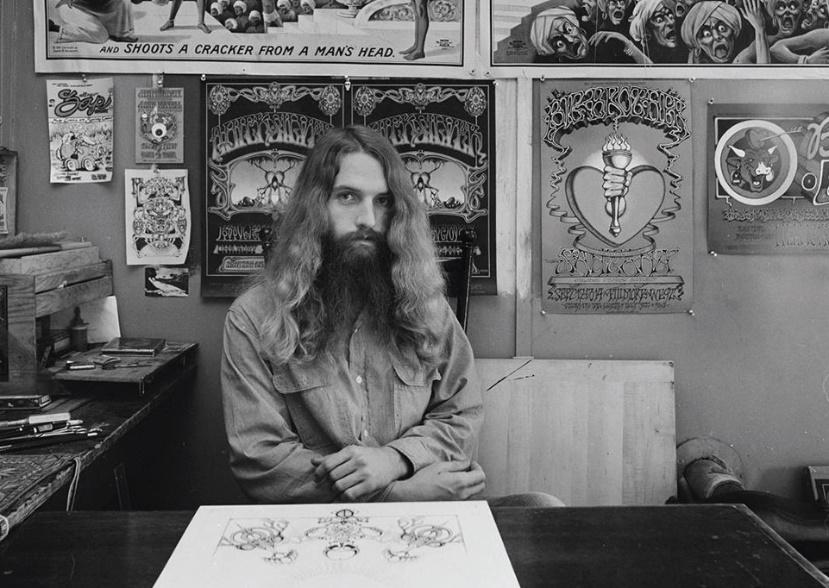
By the late 1960s Griffin had become tight with members of the Grateful Dead and began to design tour posters for them. They liked his work so much they asked him to create the cover for their third studio album which had the simplistic working title “Earthquake Country” – a reference to their hometown of San Francisco.
Griffin found the title exceptionally boring and not the least bit inspiring. Jerry Garcia agreed and solicited suggestions. In a stroke of wild, way-outside-the box genius, Griffin and band lyricist Robert Hunter decided to create a gibberish palindrome. Aoxomoxoa (pronounced “ox-oh-mox-oh-ah”) was so completely meaningless it guaranteed, along with Griffin’s psychedelic cover, the spawning of myth and legend. And this it did. It was released on the Summer Solstice of 1969.
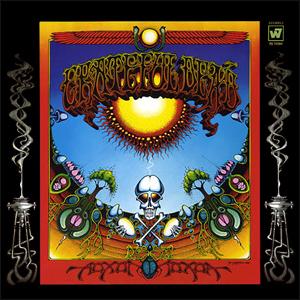
One of the Aoxomoxoa-inspired legends concerns the words “Grateful Dead” on the front of the album cover. Griffin painted it in tight, flowing, calligraphy that floats above – and lords over – the psychedelic scene below. Some fans claim this to be an ambigram that can also be read as “we ate the acid”. That certainly would be fitting of the project and the deliberately nonsensical title. Think about it: No doubt the band DID eat the acid. But for the life of me, if Griffin made an ambigram here, I cannot see it despite my great desire to do so. Nothing titillates the imagination more than secret meanings encoded in mass-market messaging, especially with offthe-wall rock bands.
I have a copy of the original LP album and have dwelled on it long and hard, trying to see the “we ate the acid” message. I’ve turned that thing sideways-left, sideways-right, upside-down, and every angle in-between. I’ve viewed it in sunlight, blacklight, and moonlight. I’ve looked at it through reading glasses, sunglasses, and even solar-eclipse glasses. I’ve used two eyes, one eye, and four eyes. Alas, I just don’t see it. But maybe I’m missing something here- perhaps if I ate the acid, I would see it? If so, it’s not gonna happen. I can live without seeing it.
Back to the project:
Aoxomoxoa was possibly the first rock album to be recorded using 16-track technology. The band had, in fact, already recorded it in standard 8-track during six months in 1968. But when their studio procured one of the very first sixteen-track recorders, Garcia and company were enthralled. They quickly recognized the game-changing aspects of the new technology. It broadened their musical horizons so much they decided to toss everything they’d already done – which was the entire album! – and record it all over again from scratch. It was pointed out that such a move would run them into very deep debt with Warner Brothers. They did it anyway and Rock and Roll history is much the better for it.
By this time – mid 1969 – the music world was already flipped on its head with establishment of Rock and Roll as a bona fide genre next to Blues and Jazz. But now, as suggested by Griffin’s phantasmagorical sex-inspired cover art for Aoxomoxoa, new acoustic lifeforms were being born and gaining a foothold in the industry – Psychedelic Rock and Acid Rock among them. But what the Grateful Dead created, especially in this album, was their own unique off-spring: A signature sound that persisted throughout their career and became known as Psychedelic Folk.
I loved Griffin’s work and collected several posters and shirts with his art. My favorite Griffin image is his now-classic “surfing eyeball” first done in 1981, featuring a detached eyeball with flailing arms and legs riding a blazing surfboard through a ring of fire. The eyeball imagery appeared in Griffin’s art after he was involved in a car wreck where he sustained serious injury to his head and trauma to one of his eyes. After he recovered, he grew a beard and periodically wore an eye patch.
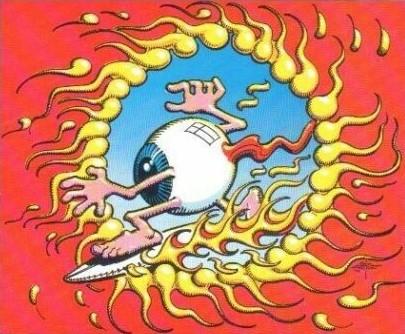
I scored one of Rick’s surfing eyeball T-shirts shortly after they hit the streets in the early 80s. I loved that shirt so much that I took special care of it, treating it like a top-shelf formal dress shirt and wearing it only on special occasions. I learned to surf in ’94 and thereafter traveled regularly to California for the winter swells.
In October ‘97, I was changing planes in San Francisco, hustling between gates while wearing the worn, but intact, Griffin surfing eyeball shirt. Serendipitously, this was just at the start of the American Academy of Ophthalmology’s annual meeting in town, as evidenced by ads for same throughout the terminals. It was mere coincidence that I happened to be wearing the eyeball shirt as I trudged through the ophthalmology-festooned airport. As I hustled between flights, I passed a guy going the other way who did a double-take of my shirt. He quickly reversed course and came running up to me.
Hey, where did you get that shirt? It’s fantastic! I told him I’d had it for over a decade.
I gotta have one! he said. I replied that, as far as I knew, they were no longer available.
Well, how about I buy that one from you right now! I’ll pay double whatever you paid for it. I didn’t really remember what I’d paid for it – maybe $10?
OK, then I’ll pay you $50 for it! I considered it and said, Nah… Rick Griffin was THE MAN! The top Kahuna. I can’t sell it.
He then offered $100. I stopped walking, thought about it for a second: I could definitely use the dough. Then I took a line straight out of the movie “Planes, Trains and Automobiles”: Well anyone who’d pay that much for a T-shirt is crazy. And if they ARE crazy, they’d probably pay $250 if they really wanted a classic like this.
To my astonishment he said SOLD!
Show me the money, I said.
He did, pulling out his wallet and peeling off five Ulysses S. Grants. I set down my bags and started to pull the tee over my head, being careful not to tug too hard on the threadbare cloth. But as I was doing so, I looked through the fabric and saw the eyeball staring at me. I paused and looked back at it. Then I slid the shirt back down.
Sorry, man. I just can’t do it. It means too much to me… I picked up my bags and walked on down the hall to my flight.
Rick Griffin died as a result of a motorcycle on August 18, 1991. He was thrown from his Harley-Davidson motorcycle when he collided with a van that suddenly turned left as he attempted to pass it. He was not wearing a helmet and sustained major head injuries. He was 47. His death sent a shockwave throughout the alternative art world and was particularly felt in California and among his friends in the Grateful Dead.
The real money in performing arts is live shows. And that’s how the Grateful Dead became so successful. They gained a committed, almost cultish, fanbase mostly by word of mouth. In counterintuitive – but appropriately antiestablishment – contrast to other bands, the Dead allowed people to record their performances and share them freely. This policy ensured meaningful appreciation for their music and, more importantly for the band, greater market penetration. It’s safe to say that no other rock band in history has ever had such extraordinary success despite having only one top-40 hit (Touch of Grey got to number 9 on Billboard’s chart) in their 30-year career.
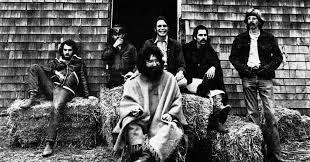
But it wasn’t easy. With success comes the devil. As anyone who’s done it will tell you, touring is a dog’s life. Jerry Garcia, especially, had a hard time of it. Although a founding member of the band, he disavowed being the “leader”. But the management knew different, and they pressured Garcia and the band into an unrelenting tour schedule.
No one felt the stress more than Garcia, who was diabetic. In the early years he famously paid little attention to his own health. Instead, he smoked like a chimney, drank like a sailor, and did drugs like a Dead-head. As a result, in 1986 he collapsed in a diabetic coma that lasted five days.
After that, Garcia realized he was headed for disaster and on a few occasions checked himself into rehab facilities. But the fix never lasted and soon he was back touring and self-medicating. Sadly, the end was predictable. Jerry Garcia died of a massive heart attack on August 9, 1995, almost exactly four years after Rick Griffin. He was 53.
AFTER WORDS
Truckin’ became one of the signature songs of the Hippy Era. Anyone who liked Rock & Roll was playing that in their head for years. I sometimes still do. It was released by the Grateful Dead in November 1970 on their album American Beauty.
Back then, “the establishment” was downright scared of Rock & Roll and the influence it was having on the youth of America. Everywhere they went the police were constantly hassling Rock bands. The Dead were raided so many times it became commonplace and expected. So, as was their way, they wrote a song about it. The lyrics in Truckin’ refer to a drug raid of the band’s hotel rooms in New Orleans early in 1970.
Ironically, nearly three decades on, Truckin’ was recognized by the United States Library of Congress in 1997 as a national treasure!
PS – If you look closely at the image of Rick Griffin above, you’ll see the art piece he is working on is the beginnings of the cover for Aoxomoxoa. At that time, it was going to be just a concert touring poster. History had other plans.
PSS – If you’ve been paying attention – and I’m sure you haven’t, but you’re not alone, I haven’t either– you will note that this is the third in the Psychedelics series. But if, by chance, you actually have been paying attention, you will remember that you’ve already received Psychedelics #4 – Burning Desire: The Jimi Hendrix Experience. So what gives? Simple: I had intended to write about Rick Griffin before Jimi Hendrix, but Hendrix got me all caught up in the Burning Desire thing and so it came out first.